
Make Your Second Osaka Street Kart Ride a Different Season: How Peak and Off-Peak Times Change What a Couple Sees
Make Your Second Osaka Street Kart Ride a Different Season: How Peak and Off-Peak Times Change What a Couple Sees
Think back to your first ride for a moment. The engine kicked into life outside the shop in Minamihorie, and you set off behind your guide. What was the first thing you noticed? Sidewalks packed with people? Or street trees swaying in a cold wind?
It's the same Osaka and the same Street Kart tour, but a different season or day of the week shows you a lot of different things. Live in this city and you see that clearly. Dotonbori on an August night and Dotonbori on a February afternoon really do feel like two separate cities.
This article is for couples wondering whether to ride in Osaka one more time. We'll go through it step by step: what changes when you pick a different time from last time, how to use a short stay, and where to take your photos.
What Season Was Your First Osaka Trip?
Planning your second trip starts with checking your memories of the first.
This is the key point. Your first Street Kart ride is packed with information: the guide's signals, the distance to the kart ahead, traffic lights, intersections, neon sliding past on either side. Just getting used to all that probably kept you busy. So first-ride memories tend to boil down to one big feeling: "That was so much fun!" Nothing wrong with that. In fact, it's completely normal.
The second time, though, you'll have a little more room in your head. Your body already knows the routine, so you have attention to spare for your surroundings. So ask yourselves: was last time during one of Japan's big holiday periods, or on an ordinary weekday? Were you drenched in sweat, or did you have your collar turned up? How crowded were the sidewalks?
Once you know your conditions from last time, the conditions to pick for round two become pretty clear.
Osaka changes its face with the seasons. Make your second trip about seeing a side of the city you haven't seen yet.
Peak vs. Off-Peak: 3 Things That Change from Behind the Wheel
"Peak season" and "off-season" are handy terms, but they're a bit too broad. From the seat of a street kart, three main things change.
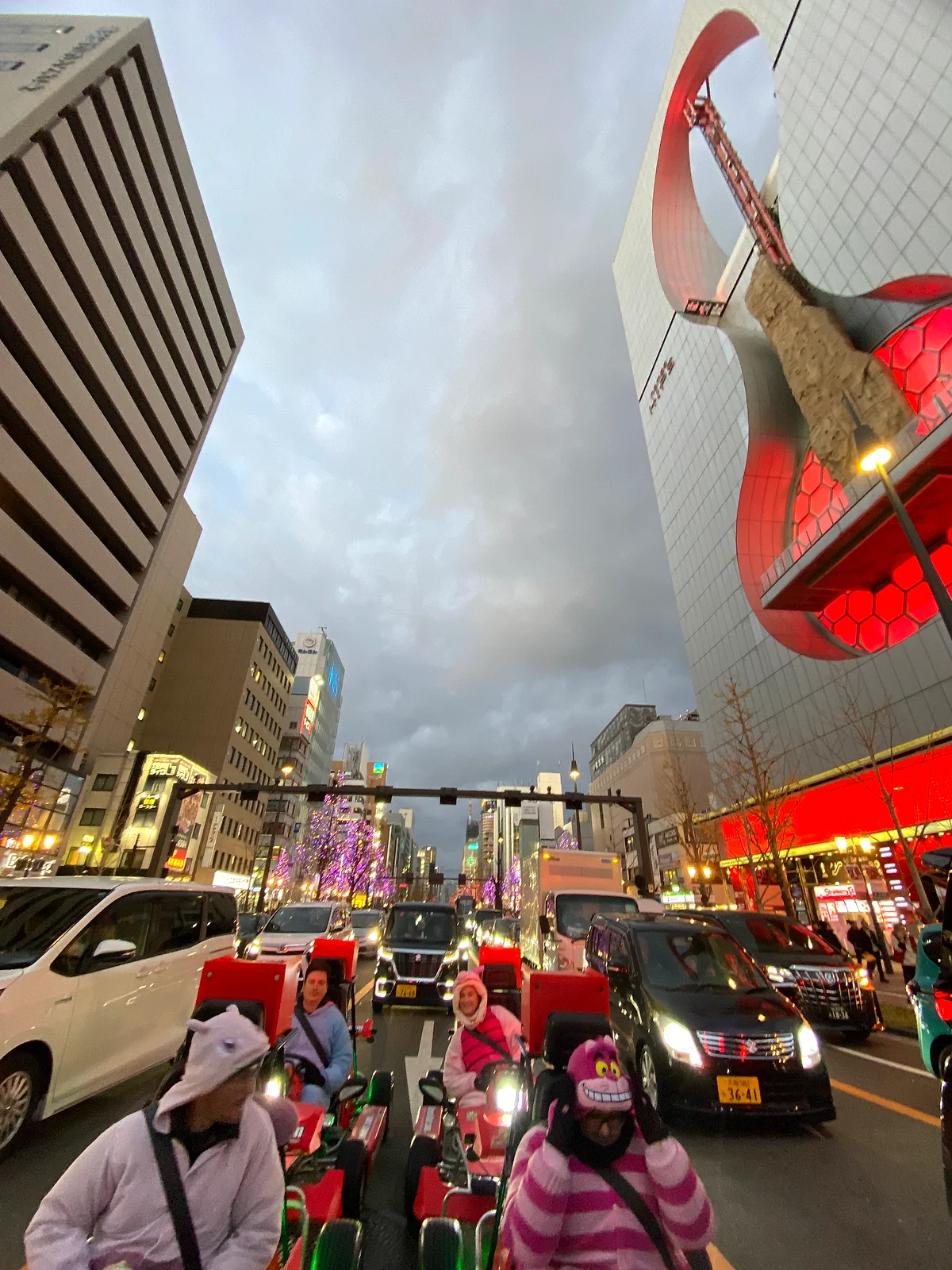
Domestic travel in Japan tends to bunch up around the big holiday periods: Golden Week, Obon, and New Year. On days like that, the flow of people around Dotonbori and Shinsaibashi becomes part of the scenery. Heads bobbing along the sidewalks, people stopping to take photos, lines stretching out from shop fronts. From the kart's low seat, you look up at all of it.
On quieter days, it's the buildings themselves that catch your eye. The colors of the signs, the shapes of the arcade entrances, the murals in Amerikamura. Things that were hidden behind the crowds come into view.
Neither one is better. If you want to soak up the energy of a crowd, go on a busy day. If you want a good look at how the city is built, go on a quieter day. Just pick the opposite of last time, and the same streets should feel like a different place.
Osaka summers are hot, with strong sun and heavy humidity. With the seat so low, you can sometimes feel the heat coming off the asphalt up close. In exchange, the moment a breeze hits you feels amazing.
Winter brings dry air, and on some days everything looks sharp and clear. But once you're moving, it feels a lot colder. Karts have no roof and sit low to the ground, so the wind and the sounds of the city reach you directly. That's the heart of what makes street karting fun, and it's also what shows you the difference between seasons most honestly.
Sunset times shift with the seasons, so I can't promise that riding at a certain hour means you'll see the neon. When you book, look up the sunset time for that day. It'll give you a better idea of what the streets will look like when you ride.
One thing is certain: Street Kart weekend slots tend to fill up fast.
So when planning your second ride, start by checking whether you can go on a weekday. If your itinerary only leaves room for a weekend, booking early will save you some worry.
If other travelers are on the same tour as you, that's part of the fun too. After the ride, try saying "Where are you from?" outside the shop. Even without a shared language, a smile and some gestures will get you through. People in Osaka have been doing business that way forever, so trust me on this!
Second Time Around, Try the Opposite Conditions
Let's get specific. What to try on your second ride depends on what your first one was like.
If your first ride was during a midsummer holiday, you probably remember the heat and the crowds. The area around Dotonbori was overflowing with people, and you might have heard voices from the sidewalk mixing with the engine noise. That's Osaka's energy in its purest form.
This time, think about a weekday in a cooler season. On a quieter day, your eyes will drift to the shapes of the buildings as you ride. What the entrance to the Shinsaibashi arcade actually looks like, what colors the shops along the streets of Amerikamura are painted. Things you missed last time because you were watching the crowds should jump right out at you.
In the cold months, what you wear matters. Riding means taking the wind head-on, so it feels colder than walking around. Wear layers so you can adjust. That said, there may be rules about clothing and belongings during the tour, so check the details on the official website beforehand.
If your first ride was on a quiet winter day, this time you might go soak up the buzz. Osaka in a warm season, at a busy time of year. The crowds on the sidewalks become the city's heat, and people gather under the neon. That Osaka is nothing like the quiet one.
If you ride in summer, preparing for the heat comes first. Drink water often, protect yourself from the sun, and don't push it if you're feeling even a little off. Being outdoors in the heat wears you out even while you're waiting to start. Osaka's summer can hang on stubbornly into September, so don't assume "It's fall now, so we'll be fine."
One more thing. On crowded days, catching the guide's instructions matters even more. The line of karts follows a set route with the guide in front. The busier it gets around you, the more closely you should watch the kart ahead and the guide's signals. Enjoy the scenery only while you're riding safely and comfortably.
Weather is one of your "conditions" too. If it was cloudy last time, you might want to aim for a sunny day. But the weather isn't something you can choose. How rainy-day tours are handled follows the policy on the official website, so read through it before you book.
If you have a spare day in your itinerary, I recommend booking your ride early in the trip. That way it's easier to adjust if the weather forces a change.
Take Your Couple Photos Before and After the Ride
Photos are probably on everyone's mind, so let me be clear: don't try to take pictures with your smartphone while you're driving. You'd have to take a hand off the wheel, and you'd spend less time watching the road. Your second ride, when you feel more at ease, is exactly when it's easiest to let your guard down.
Don't worry. You'll have plenty of chances to take photos before and after the ride.
Minamihorie is one of Osaka's trendsetting neighborhoods, full of stylish shops and cafés.
Before you set off, the area outside the shop is a good spot to photograph the two of you climbing into your karts. Check with the staff about where and when photos are okay, and things will go smoothly. Just asking "Can we take a photo here?" in English works fine.
The hard part of traveling as a couple is getting photos of both of you together. Try asking someone else on your tour: "Want to take each other's pictures?" Whatever country you're from, trading photos is an easy way to start a conversation on the road.
Amerikamura, about a 5-minute walk from the shop, is a neighborhood of vintage clothing stores and street fashion. Around Triangle Park, the way people gather says a lot about Osaka street culture.
If you shoot here, matching the colors of your outfits to the background ties the photo together. In design terms, the busier the background, the better simple-colored clothing works for making people stand out. The walls in Amemura are colorful, so white or black outfits are just right.
Dotonbori is about a 20-minute walk from the shop. The Glico sign, the Kani Doraku crab sign, Kuidaore Taro: it's crammed with classic Osaka photo subjects.
There's an old saying: "Kyoto people ruin themselves on clothes, Osaka people ruin themselves on food." Stand in front of Kuidaore Taro and it starts to look like that saying turned into a doll banging a drum.
Head down to the Dotonbori riverside walkway and you can shoot the signs from a bit further back. For neon shots after dark, the trick is simple. Rest your smartphone lightly against something like a railing to steady it, then tap the screen to set the brightness on the sign. Lower the brightness a little after that, and the sign's colors won't get blown out. If you're putting yourselves in the shot, stand on the side lit by the signs.
On busy days, keep an eye on the flow of people when you stop on the walkway. Don't get so caught up in taking photos that you block the path. The busier the spot, the more a little courtesy makes your photos feel good.
How to Plan Before and After the Ride When Time Is Short
If your second trip is a short one, think about how you'll spend the time around your kart ride. With limited time, what you do before and after the ride decides how full the trip feels.
First, getting there. The shop has no parking, so come by public transport. The nearest station is Nishi-Ohashi on the Osaka Metro Nagahori Tsurumi-ryokuchi Line, about a 3-minute walk away. Yotsubashi Station on the Yotsubashi Line is about a 5-minute walk.
In busy periods, you'll probably run into waits wherever you go. Rather than cramming in plans, it's realistic to stick to the area around the shop.
Walk around Amerikamura before the ride, then afterward stroll through the Shinsaibashi-suji shopping arcade to Dotonbori. This route doesn't need any train transfers. For food, try okonomiyaki at Chibo, about a 10-minute walk from the shop, or stop in Dotonbori for takoyaki at Kukuru or a bowl at Kinryu Ramen. Huffing and puffing over hot food right in the middle of the crowds is one of the joys of a busy season.
On quieter days, you can go a bit further.
Kuromon Market, about 10 minutes by train, is known as "Osaka's kitchen," and you can graze on seafood as you walk. Osaka Castle, about 20 minutes by train, has its main keep, a big park, and a plum grove. The park's colors change with the seasons, so on your second visit, look for scenery you didn't see last time. Abeno Harukas, about 15 minutes by train, has the Harukas 300 observation deck. Looking down on Osaka right after riding through it gives you a sense of how far the streets you just drove stretch.
For couples who want a slow dinner, Hozenji Yokocho, about a 20-minute walk from the shop, is also a great choice. Its narrow stone-paved alleys are lined with kappo and Japanese restaurants, and just a few steps away from the Dotonbori crowds, the atmosphere completely changes. It's Osaka's other kind of night, different from the bright neon.
When you travel as a pair, one of you saying "Let's stay here a little longer" throws off the schedule. That's a good thing. That's what travel is.
Still, give yourselves plenty of time around the ride so you aren't late for your booking. My advice: before your booking time, only plan things you wouldn't mind skipping. Cafés and walks can be cut short anytime. Save restaurants with lines and places with fixed entry times for after the ride.
Why People Choose Street Kart
If you're thinking about a second ride, you already know what the experience is like. Still, here's a quick rundown of what sets it apart.
First, trained guides lead the way. Each shop has a set route, and participants ride in a line behind the guide. It's not a race. It's a tour where everyone rides through the same city together.
Second, guidance on the day of the tour is basically in English. Guidance in Japanese or other languages depends on the staff that day, so it can't be promised. If you're unsure about English, get in touch through the official website beforehand.
Third, the website is available in 22 languages. You can check booking conditions and notes on the official site before you reserve.
Fourth, the track record. As of November 2023, across all shops combined, there had been over 150,000 tours, over 1.34 million customers, over 20,000 reviews, and an average rating of 4.9 out of 5.0. All of these figures are as of November 2023.
Fifth, the location of the Osaka shop. The Minamihorie shop is about a 5-minute walk from Amerikamura, and within walking distance of Shinsaibashi, Dotonbori, and Namba.
Sixth, there are 9 shops nationwide in Tokyo, Osaka, and Okinawa (7 in Tokyo, 1 in Osaka, 1 in Okinawa). Of the 7 Tokyo shops, the 2 in Akihabara are at almost the same location, and so are the 2 in Shibuya. Couples who rode in Osaka can pick a different city on their next trip to Japan.
Things to Check Before You Book
Even on your second ride, things may have changed. Don't go only on what you remember from last time. Check the official information again before booking.
Driver's license requirements differ by country and license type. Be especially careful if you're joining with a different license than last time, or if your partner will be driving for the first time. For details, please check the Street Kart official website.
Prices vary by season and time of day. Don't count on what you paid last time. Please check the official website (kart.st) for the latest information. You'll also have peace of mind if you check departure times, tour length, and rainy-day policies in the official information before booking.
Bookings are accepted via Facebook, LINE, and email. Please see the official website for details. Weekends fill up quickly, so couples who want to ride on a weekend should get in touch early, as soon as their itinerary is set.
The Same Osaka, Seen Again from a New Angle
On your first Street Kart ride, the two of you met either the lively side of Osaka or the quiet side. This time, just go meet the other one. The heat and buzz of a warm season or the sharp views in cold air: either works. Just change the conditions from last time, and the same tour starting in Minamihorie becomes a completely different memory.
The same thing happens with music. Your favorite song sounds completely different on a summer beach than on a winter night walk. Osaka works the same way. When the season changes, so does the beat.
So go ahead, open up your travel dates and see if there's a weekday you can ride. If only weekends are free, book early to be safe. You can check the requirements and the latest information on the Street Kart official website.
Come back and take the wheel in Osaka together one more time. The streets of Minami will be waiting for you again!
This article was originally written in Japanese and translated using AI. Some expressions may read unnaturally, and we appreciate your understanding. For the most accurate and up-to-date information, please refer to the official site at kart.st.
Street Kart is not affiliated with Nintendo or the Mario Kart series in any way. We do not provide costumes of Nintendo characters, and such costumes may not be worn during tours even if brought by participants.