
A Second Trip to Minami-Horie, Osaka: The Everyday City Between the Tourist Spots
A Second Trip to Minami-Horie, Osaka: The Everyday City Between the Tourist Spots
You throw your arms up for a photo with the Glico sign behind you in Dotonbori. You get carried along by the crowds on Shinsaibashi-suji shopping street, puffing and blowing on a mouthful of hot takoyaki. For your first trip to Osaka, that's exactly right. It's plenty of fun on its own!
But if your second trip just repeats the same spots in the same order, you're missing something. Between the famous signs, there are people who work here, shop here, and zip past on their bicycles every day. Why not make your second Osaka trip about seeing what's in between?
What You Saw the First Time, and What You Didn't
On a first visit to Osaka, it's the big things that catch your eye: huge signs, neon, queues, crowds along the river. They're all worth the trip, so that makes sense.
But when you scroll back through your photos afterward, they're all landmarks. The streets you walked between those landmarks are often just a blur.
Some of you probably took the subway from one landmark to the next on your first trip. While you're underground, you skip the whole city above you. Out through the ticket gate to one sight, back through the gate to the next. If you can't remember the streets in between, it's not because you missed them. You never walked them in the first place.
Before your second trip, try lining up the photos from your first one. If you look through them in the order you took them, you'll notice gaps between them. The gaps you can't fill from memory are good candidates for where to go this time.
That goes double when you drive a Street Kart. Your first time out, most of your attention goes to the guide's signals up front, the traffic lights, the cars around you, and how the steering feels. You may think you're looking at the city, but mostly you're looking at the road right in front of you. That's how it should be. Safe driving comes first.
Still, when you have some breathing room, like when you're stopped at an intersection, take a quick look around: the shopping bags in the hands of people on the crosswalk, someone folding cardboard boxes outside a shop, the bicycles lined up along a guardrail.
Walking Around the Shop: The Real Minami-Horie and Yotsubashi
Street Kart's Osaka shop is in Minami-Horie, a neighborhood full of stylish shops and cafés. If you know Tokyo, it feels a lot like Daikanyama or Ura-Harajuku. The nearest station is Nishi-Ohashi on the Osaka Metro Nagahori Tsurumi-ryokuchi Line, 3 minutes from the shop on foot. You can also walk there in 5 minutes from Yotsubashi Station on the Yotsubashi Line. The shop has no parking, so take the train both ways.
Here's my suggestion for repeat visitors: treat the few minutes from the station to the shop as a stroll, not just a commute. When you come up from Nishi-Ohashi Station, put the map app in your pocket and watch the street as you walk. Minami-Horie has plenty of cafés, so it's a nice place to take a breather before your tour. There's also a convenience store within a 5-minute walk of the shop where you can pick up drinks.
You could also use a different station on the way back. Arrive at Nishi-Ohashi and leave from Yotsubashi. Both are a short walk from the shop, but taking a different route means different storefronts and different people passing by. Seeing the same neighborhood from two directions makes the outline of Minami-Horie a little clearer.
Minami-Horie's streets aren't really built for tourists. They're for the people who work there and the people who come to shop. Someone wiping the glass of a shop before opening, someone putting a sign out in front of a café, someone rattling past with a delivery cart. Nothing flashy, but it shows you how Osaka locals actually use their own neighborhood. What you see changes from day to day, so walking together and asking each other "Did you see that?" is half the fun.
Yotsubashi is right next door to Minami-Horie, and lots of young people pass through. A kid carrying a bag from a vintage clothing store, a guy on a bike waiting at a light. Pay attention to small details like the width of the sidewalks, the height of the buildings, and the spacing between shops, and you'll see the city moving to a completely different rhythm than Dotonbori, even though it's all Osaka.
One more thing: look up now and then. In some buildings, the ground floor is a shop but the upper floors are offices or homes. Potted plants on a balcony, a handwritten note taped inside a window. Unlike tourist-area signs, these aren't meant for anyone to see, and that's exactly why they show the city's real face.
The "In-Between" Scenery from Behind the Wheel
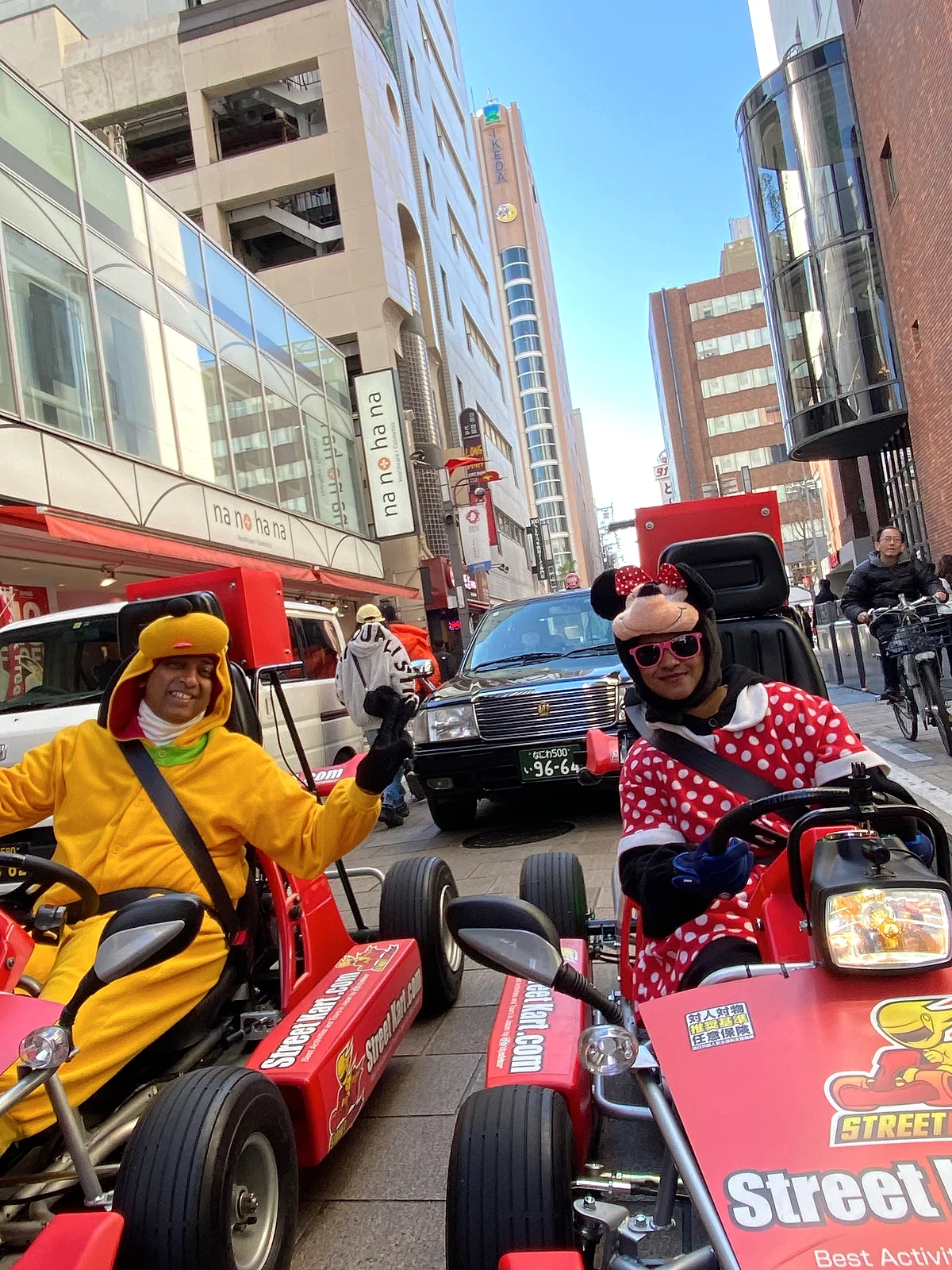
Once the tour starts, everything looks different. Your eye level drops way down, and the walls of the buildings tower over you. The tires of the car next to you feel like they're right there. The wind hits your face and the sounds of the city come straight to your ears. It's nothing like walking, and nothing like watching from a train window.
The Osaka tour runs through Minami, Osaka's southern downtown: from Minami-Horie through Amerikamura, Shinsaibashi, Dotonbori, and Namba. A guide leads the tour, so you don't pick your own route. And that's exactly why you can stop thinking about where you're going and focus on what to notice in the neighborhoods you pass through.
Watch for the moments when one neighborhood turns into another. From Minami-Horie's clean, orderly streets to Amerikamura, lined with vintage clothing shops. From that vintage-and-streetwear district to Shinsaibashi, with its department stores and big shopping buildings. Then on to Dotonbori, with the Glico and Kani Doraku signs, and Namba, home of Namba Grand Kagetsu. In a kart, these changes come one after another within just a few blocks. On your second trip to Osaka, you should be able to catch the moment the sign colors, people's clothes, and the music from the shops all change.
If you're into music, think of it as the city's BPM shifting. Minami-Horie is mid-tempo house. Step into Amerikamura and the beat gets a little rougher. Dotonbori is suddenly peak time on the dance floor. It's just a metaphor, of course, but feeling that shift in your body with your hands on the wheel is something only a kart can give you.
After the tour, when you're back at the shop and climbing out of the kart, your ears may still be ringing with the buzz of Dotonbori. If you notice how quiet the streets of Minami-Horie feel then, that's proof you felt the neighborhoods change with your whole body.
Two important things. Don't pick up your smartphone while you're driving. And only look at the scenery when you have room to spare. When the guide gives a signal, get your eyes back on the road immediately. Anything you wanted to photograph or missed, you can walk back and see after the tour.
Things to Keep in Mind on Your Second-Trip Tour
On your first kart ride, just taking in the pre-departure briefing may be all you can manage. That's fine. How to drive, what the guide's signals mean, the rules for stopping: listen carefully to all of it first. Once you know the routine, you'll feel more relaxed after you set off, and you'll have more attention left for your surroundings.
The other tip: don't try to see everything. The signs and neon you saw last time? Let them slide by this time. Instead, pick one theme for the neighborhood transitions, like "today I'll only look at storefronts" or "today I'll only look at what people are wearing." Even on your first kart ride, if you've decided on one thing to look for, you only need to glance at it when you have room to spare. Apparently designers find more when they look at a city for just one thing, like only color or only empty space. Same idea.
After the ride, jot down some notes while it's still fresh. Which intersection, what caught your eye. A word or two for each is enough.
If You're Going as a Pair: Photos After the Ride, On Foot
Karts are single-seaters, so if two of you join, you'll each drive your own kart. You may spend some of the time driving side by side, but you can't take photos of each other while driving. So the best time for photos is on foot, before or after the tour.
When you each drive your own kart, you often notice very different things, even on the same road. After the tour, ask each other: "What stuck with you the most?" A lot of the time, your partner will remember a storefront or intersection you don't remember at all. Comparing notes like that turns into a map for the walk afterward.
Amerikamura, a 5-minute walk from the shop, has Triangle Park. It's a small plaza surrounded by vintage clothing stores and other shops, and locals will know exactly where you mean if you say "meet at Ame-mura's Triangle Park." People sit around resting or waiting for someone. It's not a flashy photo spot, but a shot here really captures that "I was hanging out where Osaka's young people hang out" feeling. It's also nice to go back over a road you drove through, this time at walking speed.
Shinsaibashi-suji shopping street, about a 15-minute walk away, is a covered arcade that seems to go on forever. Last time, the crowds may have overwhelmed you. This time, try shooting from a bit farther back. The stream of people flowing deep into the arcade, the rows of signs, someone stopping to peek into a shop. If you shoot it as an everyday street people actually live along, not as a tourist sight, you'll get very different photos from last time.
Dotonbori, about a 20-minute walk away, is home to the Glico sign, the Kani Doraku sign, and Kuidaore Taro. From the Dotonbori River promenade, you can also look at the signs across the water. Plenty of you probably photographed this spot the first time. This time, instead of the signs themselves, try including the people walking past them or chatting while leaning on the riverside railings. Same place, but now the photo shows the city's warmth.
Hozenji Yokocho, also about a 20-minute walk away, is lined with kappo restaurants and other Japanese eateries. It's not far from Dotonbori at all, yet the mood calms down right away. Listen for how the sound changes when you step one street off the busy strip.
If you're shooting at night, brace yourself against a railing or pillar to hold your camera steady. That cuts down camera shake a lot. Neon is bright, so lowering your screen's exposure a little helps keep the colors from blowing out. And if you're photographing shop workers or passersby head-on, ask first or frame the shot so their faces aren't clearly visible. That's basic courtesy. If asking feels awkward, even a small nod goes a long way.
How to Plan Your Limited Time
If you're traveling as a pair on a tight schedule, don't try to cram in as many sights as possible. Put the tour in the middle and fill the time before and after with Osaka on foot.
Before the tour there's check-in and a safety briefing, so give yourself plenty of time to get to the shop.
If you're doing the tour on the day you check out of your hotel, plan for your luggage. The shop has lockers for small items, but they're not suited to large bags like suitcases. Leave big luggage at your hotel or a station and head to Minami-Horie with nothing to carry. Walking around after the tour will be much easier too.
After the tour, spend your time walking to the places from the previous section. The intersection you just zipped through, you now cross on foot, mixed in with everyone else waiting for the light. The city from a kart and the city on foot: once you have both views, your mental map of Minami starts to fit together into one picture.
As you walk, pick the intersection that stuck with you most during the tour and stand there for just five minutes. As the lights change a few times, watch who crosses. You'll realize how many different people pass through a spot that went by in a flash from the kart.
For dinner, you could have okonomiyaki at Chibo, or grab takoyaki from Kukuru in Dotonbori and eat as you walk. If you have time to spare, you could take the train about 10 minutes to Kuromon Market.
Keep the weather in mind, too. In light or moderate rain, tours run as scheduled and raincoats are provided. Tours are canceled in heavy rain or typhoons. Have a backup plan ready for those days, like walking Shinsaibashi-suji, which is covered the whole way.
One thing to remember: weekends book up fast. If two of you are going, you need two slots. Once your itinerary is set, book early. If weekends are the only time you can travel, book even earlier.
Things to Check Before You Book
You need a driver's license to take part. On the day, you'll need your physical license; digital licenses aren't accepted. Bookings are handled through Facebook, LINE, or email. Tour-day guidance is generally in English. Guidance in Japanese or other languages depends on the staff that day, so it can't be guaranteed. The official website is available in 22 languages.
Wear clothes that are easy to move in. Closed-toe shoes like sneakers are recommended, and it's best to avoid sandals, heels, skirts, and dresses.
Which licenses are accepted (requirements vary by country and license type), what to bring on the day, the guide's language, how to book, how early to arrive at the shop, and what happens if a tour is canceled because of heavy rain or a typhoon: check all of these on the Street Kart official website before your trip.
On your first trip to Osaka, you saw the landmarks. This time, it's your turn to see the city that connects them. Your trip starts the moment you climb the stairs out of Nishi-Ohashi Station.
This article was originally written in Japanese and translated using AI. Some expressions may read unnaturally, and we appreciate your understanding. For the most accurate and up-to-date information, please refer to the official site at kart.st.
Street Kart is not affiliated with Nintendo or the Mario Kart series in any way. We do not provide costumes of Nintendo characters, and such costumes may not be worn during tours even if brought by participants.